An analytical impact article
NMR Spectroscopy Impact in Analytical Chemistry
NMR Analysis Generates Multiple Opportunities
Nuclear magnetic resonance (NMR) spectroscopy is one of the most versatile and useful analytical techniques for investigating the structure and dynamics of various molecular systems. This non-destructive technique covers a wide range of scientific applications, including chemical research and development in the pharmaceutical industry.
NMR spectroscopy, more than almost any other analytical method, quickly and easily gives synthetic chemists rich information that can guide their reaction process. Very often, extensive purification of the sample is not necessary, and good data can be acquired with very little sample size, less than 10 mg. Samples can be recovered for use in other analytical or synthesis processes.
NMR spectroscopy allows for the analysis of highly reactive compounds that cannot be analyzed safely or easily measured by other techniques. Many chemical starting compounds fall into this set of highly reactive materials; NMR analysis offers an ideal technique for quality control and GMP processes for these compounds.
Enhance Results with Intersecting Approaches
If you are working with novel small molecules, such as those in pharmaceutical research and development, NMR spectroscopy used in conjunction with LCMS can provide highly compelling evidence for identity. NMR spectroscopy can generate very rich information about molecular structure, chemical environment, functional groups, and reaction states.
Quantitative proton NMR (1H qNMR) spectroscopy offers an orthogonal approach to measure compound purity, and current pulse sequences can give reliable 13C qNMR spectroscopy as well.
Present NMR Results with Confidence
NMR results are generally straightforward and don’t require much interpretation. However, there are cases where results are not clear. The analysis of polymers is a common case: NMR signals may not be resolved clearly and may suffer a great degree of overlap. NMR spectroscopy using 13C nuclei may be helpful in these compounds as the ratio of residual monomer to polymer may be reliably determined. Furthermore, the state of the art in NMR science is constantly developing, with the introduction of advanced deconvolution and simulation computation programs which can help resolve hidden or overlapped signals.
Contracting with a team of chemists offering inter-specialty communication will help you streamline your processes, which should reduce timing issues and confusion as you work to get your innovative project across the finish line. CDMOs help ensure that your molecule will start the journey to market in a good position.
Ask Questions Early. Then Ask More.
Save time. Reduce stress. Conserve materials and money. Include analytical pros early in your development and discovery processes. Experienced NMR Spectroscopists can keep you grounded every step of the way, by advising when and where NMR techniques are relevant. This ensures that multiple analyses will provide the results you need, without a lot of irrelevant faux-results taking up resources.
Once you have established the communication pathways, keep the info flowing –in both directions– throughout your innovation processes. Your dynamic discoveries need responsive interdisciplinary collaboration to produce truly meaningful, marketable products.
About the Author
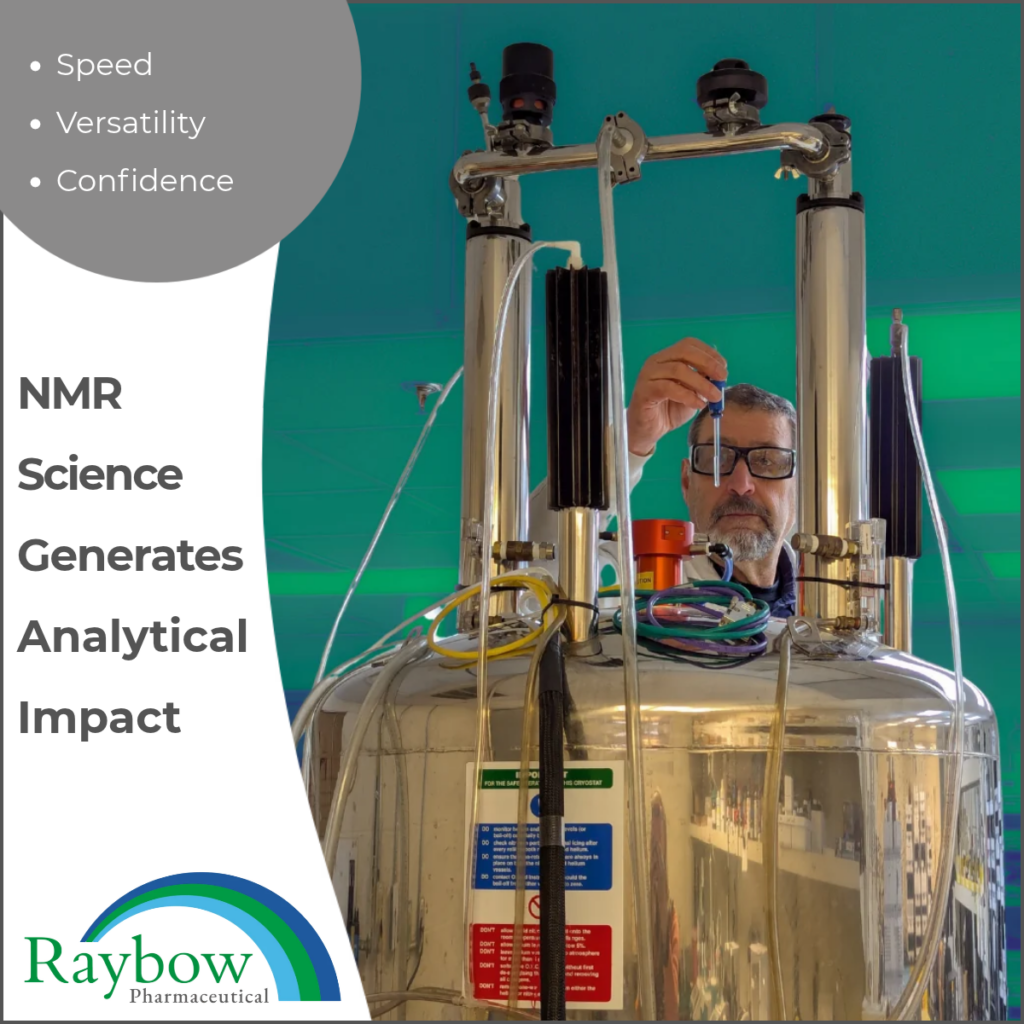
Cristobal Zomosa has been an analytical scientist for over 30 years. He earned a Bachelor of Science from the University of California, San Diego. He has worked with large laboratories such as Invitrogen and Promega and has been responsible for the maintenance and operation of the NMR lab at Raybow USA since 2019.
About Raybow USA, Inc.
Raybow USA became a US branch of JiuZhou Pharma in 2019. The Brevard, North Carolina company was founded in 1998 as PharmAgra Labs by Peter Newsome and Roger Frisbee. The laboratory currently operates a 400 MHz superconducting magnet with a Bruker spectrometer.
The facility is dedicated to cutting-edge Research & Development and Analytical Services, offering preparation of clinical trial material, method validation, and small-scale specialty production for multiple markets. The FDA-inspected site boasts a cGMP laboratory and kilo lab.
Raybow USA’s CDMO services include custom organic synthesis, process development, analytical services, tech transfer, and cGMP production for small molecules, specialty chemicals, and polymers.
Bridge discovery to supply with Raybow’s flexible solutions, regulatory expertise, and collaborative approach, all bringing innovative products to market faster.