An analytical impact article
XRPD: A Fast Path to Analytical Reliability
X-Ray Powder Diffraction Beams Up Phase and Form Identification
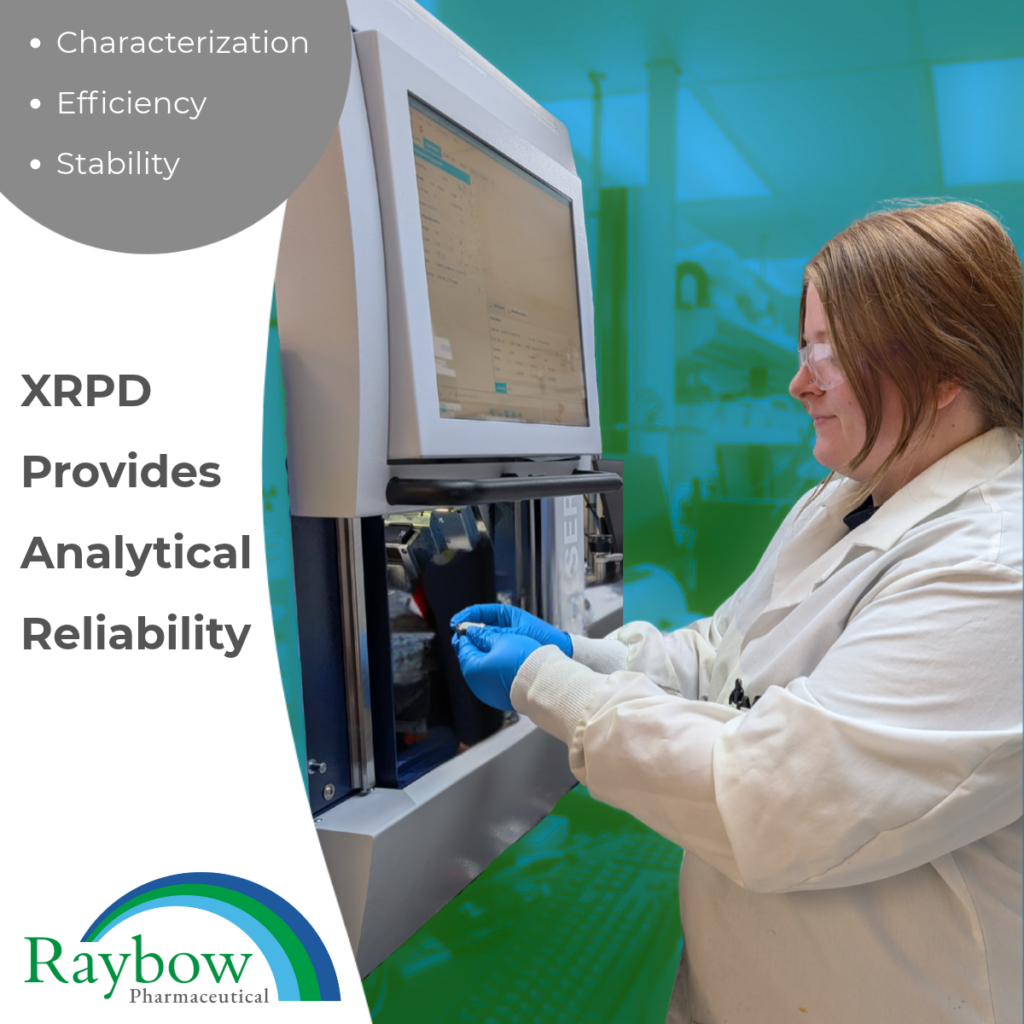
When you need a quick, non-destructive, structural analysis of your solid sample, X-Ray Powder Diffraction (XRPD) beams up accuracy. XRPD delivers reliable phase and form identification for solid-state characterization and formulation studies.
Whether you are developing an innovative product or exploring new routes to produce an existing drug product, XRPD can quickly characterize crystalline form and detect polymorphism. Used over time, it provides data about the quality and stability of your substance.
Be sure to consider pairing XRPD with other analytical methods to expand your information base. For example, when XRPD is used in conjunction with differential scanning calorimetry (DSC), diffraction data on crystal form can be corroborated by thermal events such as melting, desolvation, or form conversion. The two techniques rest on different physical principles and therefore provide orthogonal measurements, maximizing the reliability of your results.
Zero in on Crystallinity
XRPD provides measures of diffracted X-rays from the substance being tested. There are situations where XRPD would not provide useful results. Knowing where these situations exist is where experience provides insight and saves money and time.
XRPD’s best uses are with crystalline materials. Substances with long-range, repeating atomic or molecular patterns provide clear peaks in results. Testing of amorphous samples produce a broad, diffuse halo rather than a fingerprint of sharp peaks.
Since XRPD is non-destructive to samples, tested samples can be assessed in other ways after XRPD. Running multiple tests on a single sample can reduce material consumption when material is scarce.
XRPD Peaks and Valleys Need Careful Interpretation
Color XRPD reports are almost always attractive and interesting to look at. Of course, the report’s value lies in the interpretation of the peaks and valleys. Peak position (2θ), intensity, and width or shape each have meaning.
Depending on a variety of factors, the peaks can indicate crystal size, lattice strain or disorder, compound polymorphism, or the presence of an amorphous substance. Matching an unknown pattern to known standards can identify the crystalline phase or polymorphic form in a sample and determine the presence of an impurity or a desired component.
A contract with a team of chemists offering inter-specialty communication will streamline your processes and get your innovative project across the finish line. Contract Development and Manufacturing Organizations (CDMOs) help ensure that your molecule journeys to market efficiently.
Ask Early. Then Ask Often.
Including analytical experts early in your development and discovery processes saves time and resources. Experienced Analytical Chemists can keep you on track, by advising when and where XRPD is relevant, and what other tools would provide valuable information. This ensures that you get the results you need without irrelevant processes slowing you down.
Keep the info flowing to and from your analytical team throughout your project. Your discoveries, strengthened by continuous interdisciplinary collaboration, enable the development of products that are both thoroughly characterized and commercially viable.
About the Author
Ashley Spencer has over five years of analytical testing experience, including work on XRPD, LC-MS, LC-TQ, Karl Fischer, and HPLC. Spencer earned her Bachelor of Science in Chemistry from The University of North Carolina at Asheville and is employed at Raybow USA in Brevard, North Carolina.
About Raybow USA, Inc.
Raybow USA became a US branch of JiuZhou Pharma in 2019. The Brevard, North Carolina company was founded in 1998 as PharmAgra Labs by Peter Newsome and Roger Frisbee.
The facility is dedicated to cutting-edge Research & Development and Analytical Services, offering preparation of clinical trial material, method validation, and small-scale specialty production for multiple markets. The FDA-inspected site boasts a cGMP laboratory and kilo lab.
Raybow USA’s CDMO services include custom organic synthesis, process development, analytical services, tech transfer, and cGMP production for small molecules, specialty chemicals, and polymers.
Bridge discovery to supply with Raybow’s flexible solutions, regulatory expertise, and collaborative approach, all bringing innovative products to market faster.
###